
Reading Time: 5 minutes.
Thinking is an intriguing activity. You cannot see or feel it, but it is one of the most essential activities students and upcoming knowledge workers do every day. We as students think to understand knowledge, make sense of the world around us, bond with friends, and make decisions.
After we graduate, thinking gives birth to creativity leading to invention, innovation, and progression of knowledge.
Does creativity decrease as we age?
As we graduate, our age increases. Some people say that they are not born to creativity, but do you know the true story of aging and creativity?
George Land’s Ted Talk reported a longitudinal study that 1600 four and five-year-old children scored 98% on the creativity test. Surprisingly 5 years later, 30% of the children scored the same on the test. Another 5 years later, the percentage dropped to 12%. In the end, only 2% of adults were “creative.”
Funny enough, people are taught to be creative because the education system demands one correct answer on the test.
No worries, you can still retrain your creativity! And creativity is increased by 500-700% in the magical flow state!
Linear Thinking
Linear thinking is thinking traditionally with logic, experiences, and past data to solve a problem.

This mode of thinking is sometimes also called convergent thinking. Linear thinking of thinking mode is active when converging all of the information. For example, the linear method is involved when solving a math problem or writing an essay.
In a creative field, linear thinking compiles all the information into one deliverable. I might kill my darlings to make the final work sense to the audience or readers.
Pros: You can arrive at a conclusion or answer if you have already aggregated all the material you need for your problem.
Cons: Your mind falls into linear biases without noticing them. You might feel stuck in the bushes and cannot think of new solutions.
Second-order thinking
You consider the indirect effects of taking action.
- A leads to B, but possibly C.
- A is more likely to cause C to happen than B.
- If A, then B and C might be related.
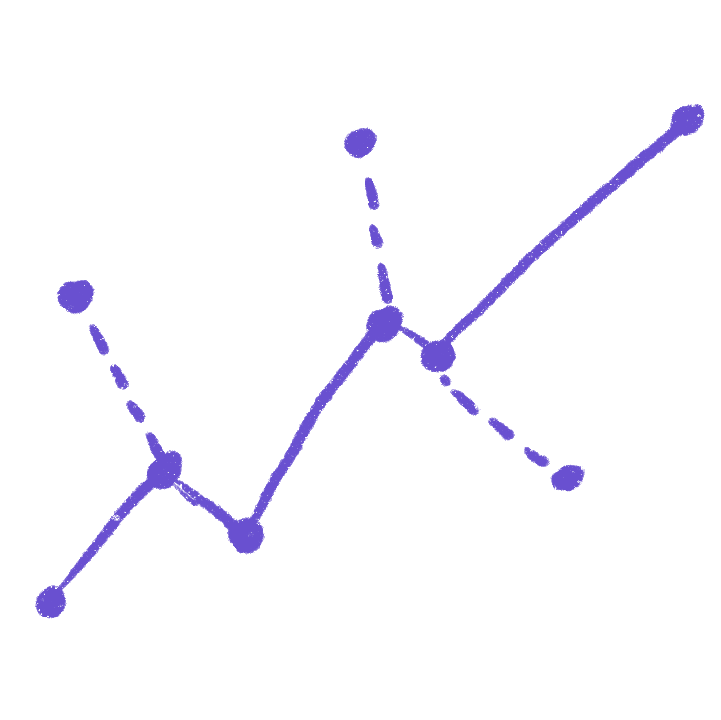
When you are doing second-order thinking, you can ask yourself the question, “so what?”.
There is a fun story to illustrate this.
The Cobra Effect
During the British’s rule in India, so many snakes were out on the streets. And the government decided to reward people who caught snakes. Many snakes are brought to the king every day, but there are still many snakes on the street.
Why?
Some intelligent people decided to take advantage of this reward. Snakes farms were popping up in the suburbs of the city. They were raising snakes and bringing them to the government for the money.
In the end, the government decided to abolish this policy. The snake farmers dumped all the snakes on the streets. The streets now had more snakes when the guidelines were implemented.
Pros: You will have a smaller chance of getting stuck in the bushes.
Cons: It can be challenging to find new connections for creativity.
Network Thinking
Network thinking can also be called divergent thinking.
- A is connected to B and C
- B is contradicting C and A.
- A can causes B and C
- C is correlated with A, but not B.
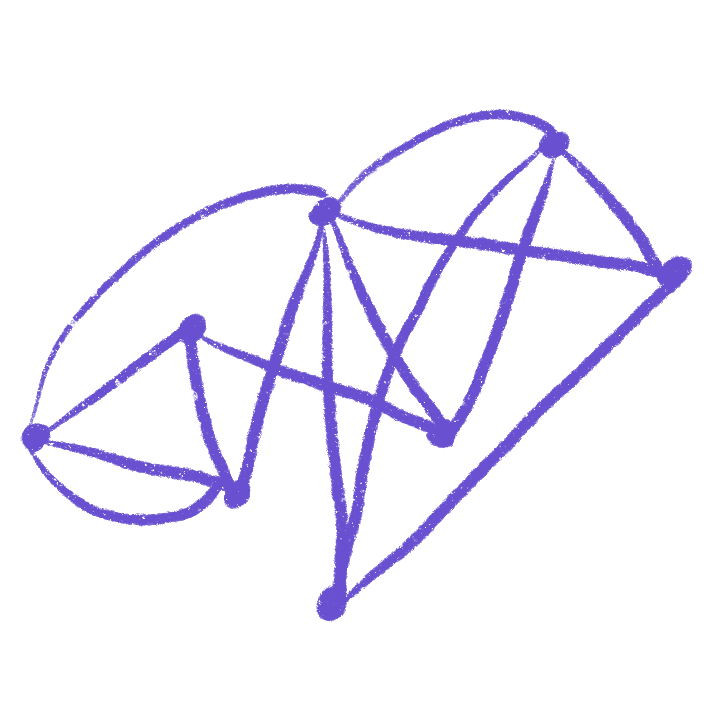
Network thinking is thinking in many directions to generate new connections with given information about the problem. This type of thinking can be overwhelming at first. Try to build a habit of “playtime” into your day to get the hang of network thinking.
Pros: Network thinking increases creativity and novel connections.
Cons: It can be challenging to converge a central argument in the final deliverable you want to convey. It is very messy, and you can feel overwhelmed with where to nail it down.
How can you put all of this into action?
So how to switch between network, linear, and second-order thinking to brainstorm and generate ideas.

1. Quality comes from quantity. Do not care if the idea is valuable to the audience or not. Just generate as many as you can from the content you have consumed. This can range from YouTube videos, art galleries, a conversation with a friend, a movie, a book, a beautifully designed cup.
Studies found that the more creative connections generated are related to a higher quality of creativity.
“We found that a higher number of responses on the divergent thinking task was significantly associated with higher creativity (r = 0.73) as independently assessed by three judges”.
As a neuroscience nerd, why not tell you what brain regions are involved in predicting divergent thinking.
“Moreover, we found that creativity was predicted by cortical thickness in regions including the left frontal pole and left parahippocampal gyrus”.
We will use network thinking to generate connections between nodes of pieces of knowledge. Network thinking does not apply to knowledge working only. The only difference to knowledge work in filmmaking and painting is that the medium of expression has changed. I create original work in painting and knowledge. This leads to the next point.
2.Understand the characteristics of your creative medium. For example, writing is the creative medium that I picked. Writing is good at expressing profound and complex ideas. Still, it is not helpful for a complete beginner to understand something works.
In contrast, a video with visuals and sounds will better illustrate something for a beginner. For example, if I want to expand on knowledge points in a video, the video will be 30 minutes long.
We do not know how many ideas we can generate. However, studies have found that humans set the bar too low when generating ideas.
3.Use second-order thinking to evaluate the value of execution and the possibility of ideas. We can uncover consequences that are not obvious with linear thinking.
4. Get your project list out and pick your medium of expression. Whether writing a blog post, making a video, or posting on Twitter, each medium has a unique language.
5. Use linear thinking to compile your ideas. I will kill my darling, prioritize, and limit the span of possibilities.
And voilà, now we have the final art piece.
 Priscilla Xu
Leave a comment