
Reading Time: 4 minutes
Do you believe that learning by listening, watching, or hands-on problem solving will improve your academic performance?
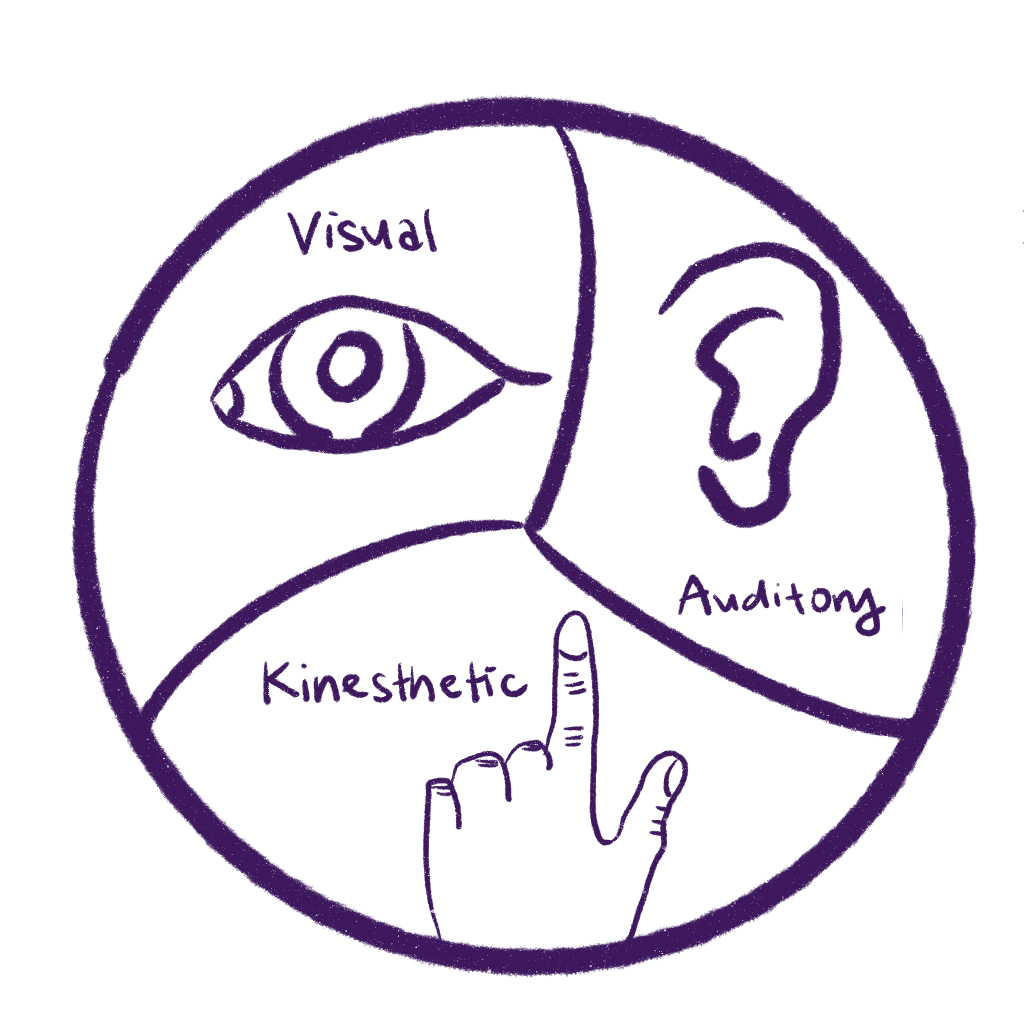
The learning style theory states that if the student learned new information with their preferred learning style, they would have more academic success than other methods (Pashler et al., 2009).
Many students still believe it despite lacking evidence.
Why do learning Styles Exist?
Learning styles are attractive because parents are interested in constructing an environment to make their children feel unique and loved. Many companies and schools can also send out paid questionaries to provide data for people who want to understand more about themselves. The National Association of Secondary Schools widely handed out the learning style test.
The theory has reached a commercialized level. The pseudoscience knowledge will most likely stay around anywhere pseudoscience has financial incentives.
The Rise of the Learning Style Myth.
People can confuse the terms learning styles and learning preferences.
First, let’s look at learning preferences. In 2006, Massa and Mayer surveyed how a student’s preference of learning correlates with what method of lecturing they will choose. The lecturing options were verbal or presented by visual illustrations. The result was that the survey is significantly associated with. In the research, Massa and Mayer found that the correlation of the two variables is significant. This study shows that learning preferences exist, but not learning styles.
In another research, Constantinidou and Backer (2002) found that the method of instruction does not impact a student’s academic success based on the student’s preferred method. First, the researcher asked the participants to self-report their education preferences and estimate how well they could retain that information. Then, the vocabulary were presented in visual drawings, audio recordings, or both methods. After a recall test of vocabularies, the data did not strongly correlate to the preferred learning method.
If the learner is a “visual learner,” information should, when possible, be presented visually.
The conclusion may be drawn from the research above, but this does not mean that they will perform better.
The difference in learning styles and preferences are just separated by a fine line.
Information can be tweaked and presented from many points of view. In addition, it also depends on the intention of the writer’s message. For example, someone who cares about opinions, popularity, and earning money might put less attention on information accuracy because there is just so much time in a day to make money instead of fact check things.
Study content creators must have the responsibility to fact-check things before they post. Learning is a very complicated cognitive process and is very difficult to be explained entirely in just a ten-minute YouTube video. In addition, it is challenging for a creator to read heavy academic literature on cognitive science to create a fact-accurate video.
Why learning is so hard to measure?
Learning is a highly complicated cognitive process.
If researchers want to validate the theory of learning styles, the claim must be falsifiable and testable. In addition, the researchers must come up with an operational definition.
An operational definition specifies concrete, replicable procedures designed to represent a construct.
Wikipedia
The definition represents a mental process that one cannot see.
The operational definition must be defined to test the learning styles theory.
What can you do at an individual level?
I love science, and it is everywhere. People can do scientific experiments at home too. However, people should not be gaining money from snake oil to despairing people, like the learning style test of the Myers-Briggs personality test.
- Do experiments with your learning style and write a reflection with Kolb’s Cycle.
- Use multi-modal learning. This means that you hit the concepts from many angles and use them in many different contexts, so you can train yourself to know what concepts to use under what type of questions.
- Fact checks the information yourself to not waste your time. If you do not find yourself as a science person, here are some simple red flags for you to spot fake science
Of course, from a socializing point of view, it is intriguing to discuss with your friends what is their preferred learning method. I do it all the time, but I just don’t take it too seriously or heatedly disagree. I trust people will be responsible for their learning and the consequences of their choices.
Shamelessly, on one of my earliest YouTube videos. I thought learning styles were actual too. The most important thing is that I have found the valid scientific truth.
Well, we live, and we learn. That’s how humans are.
 Priscilla Xu
Leave a comment