
Reading Time: 4 minutes
Humans love to categorize things. Implicit attitudes and stereotypes can intentionally harm people. Instead, we can flip this double edge sword in learning. Why not put human nature into the school’s artificial academic environment?
The Magical Number 7
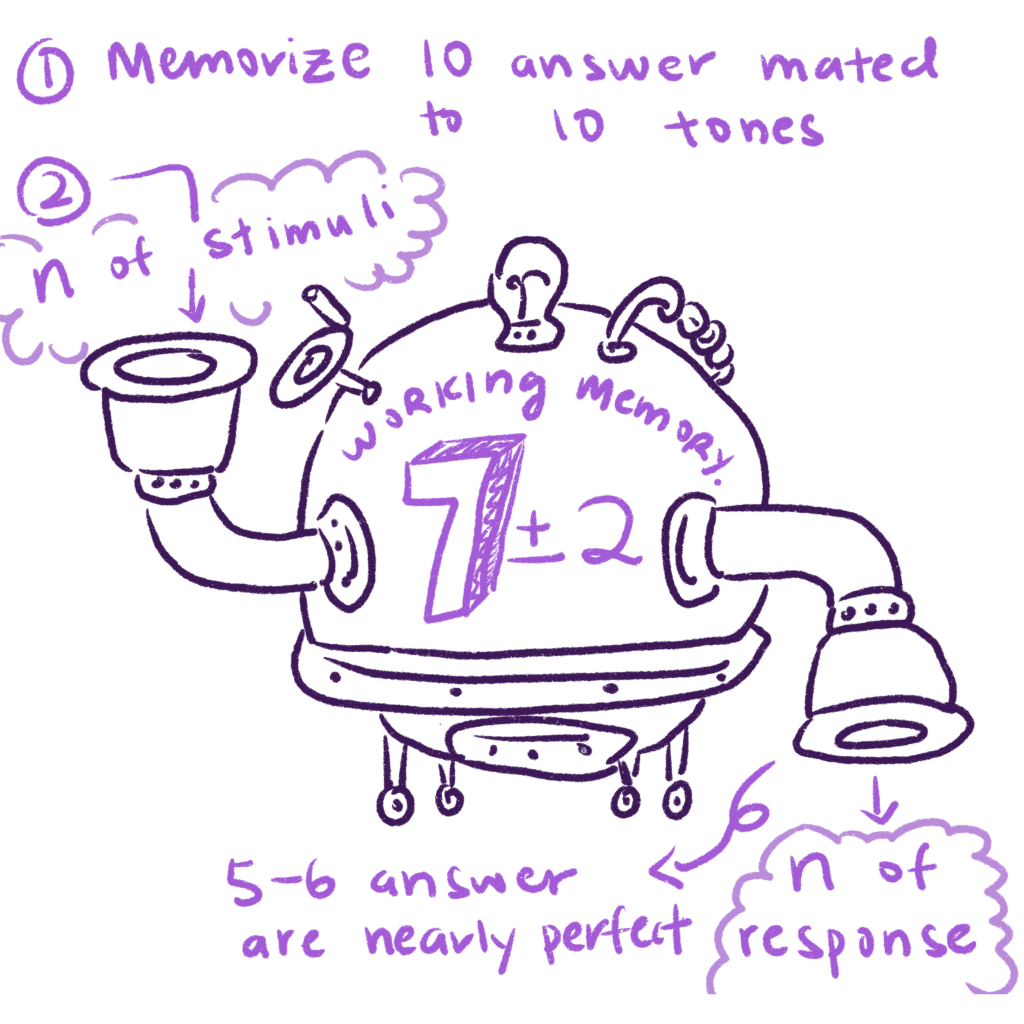
The cognitive psychologist George A. Miller of Harvard University’s Department of Psychology theorized that the working memory has a capacity of 7 bits of information plus or minus 2 bits.
He tested his hypothesis with a one-dimension judgment test meaning that one stimulus corresponds to one response. He instructed the participants to memorize answers to 10 different tones.
Then, a certain number (n) of stimuli is tested, and then the participant has to answer the same number (n) of responses as the stimuli.
Although 5 or 6 stimuli responses are close to perfect, the average letter or number that can be memorized with the working memory is seven plus or minus 2.
What is Chunking?
According to the cognitive psychologist George A. Miller of Harvard University’s Department of Psychology
Chunking is an act of reorganizing and regrouping bits of information we read in meaningful groups in connection to past knowledge.
- A chunk unit is a group that has a meaning that one person can identify and remember.
- Chunking is a method to bypass the cognitive load.
- What counts as a chunk is dependent n on the person’s past knowledge.
- For example, to a native speaker, a word is a chunk. However, to a learner, a word is may jumbled up later because the learner does not recognize the meaning.
- But, as you gain more vocabulary, the talk will not look like a group of meaningless letters.
Chunking in everyday life
- When your group phone numbers to place the digits
- When you make words out of letters.
- When you group words into an address and say it in segments for someone asking for your address.
How to Chunk
Use pattern recognition to find similar relationships
The chunking process takes a lot of mental effort and must be monitored with your metacognition. The feeling of chunking starts as very overwhelmed and confused. Then, the process slowly transitions into organized groups of interconnected knowledge instead of lonely gap islands. Here, Psychologist Amanda Gilichirst shows when chunking will happen.
Chunking can occur by two different means: either through strategic reorganization based on familiarity or prior knowledge or through grouping based on perceptual characteristics
Source
After we have grouped the bits of information according to characteristics, we can make the chunks connect to our old knowledge and pattern.
Leverage your long-term memory and old knowledge frameworks.
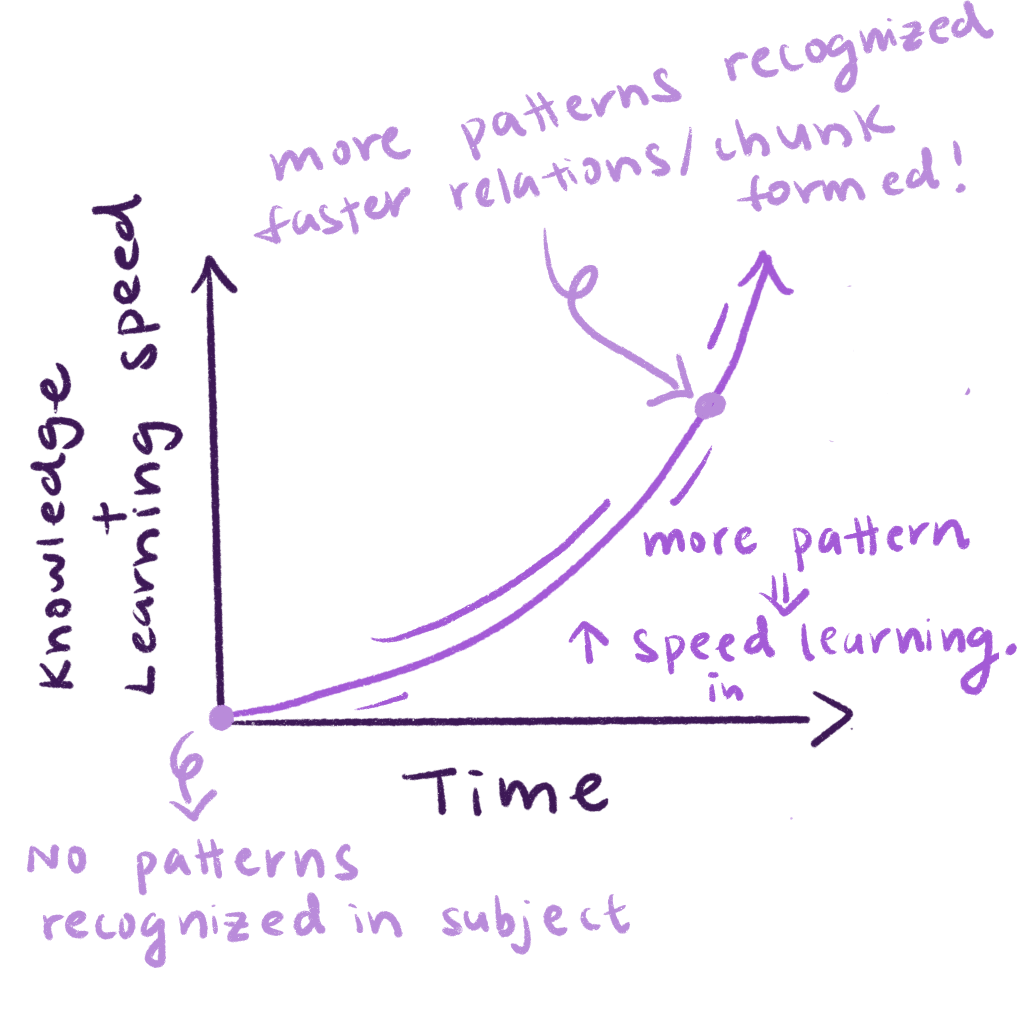
We will slowly construct our mental models from learning the basics in a domain. You can use those mental models to feel the compound effect in learning, where you know newer things in a similar environment with similar mental models.
Famous investor Charlie Munger coined the term Lollapalooza effect.
Lollapalooza effects occur when there are multiple forces or factors are combining in the same direction…
Charlie Munger
They don’t just add up; each scafold builds off and strengthens the other, creating an explosive effect with massive results.
Munger discusses the combination of mental models in terms of psychological misjudgment. The same concepts can be applied to building our mental models in reading and learning. We can achieve the compounding effect in knowledge. When we can recognize more patterns with cognitive schemas in a domain of knowledge, we can learn new concepts in the same field faster.
How can you improve your chunks?
Use pattern recognition to find analogous relationships.
In the current research, subjects look at 2500 objects in 5.5 hours. Then, the researchers showed the subjects new object images, and the old object could be paired with those new object images 90% of the time. The result showed that subjects can maintain an object’s prototype in detail from 2500 pictures.
Actions Tips
- Develop and compare the new concept to what you know already
- Leverage your hobbies and personal experience to understand the new concept you learn.
- Creating connections based on personal experiences makes.
- Connect concept outside of classrooms
- Recent new or cases are the best.
- Use the News tab in google
Develop Cleanly organized, Meaningful Chunks
- If it is good quality, you should be able to find the information in your brain when you need it. This means that your organization of chunks has to be clean.
- Other chunking methods can be organized based on knowledge application and relating to personal experience to increase relevance so you don’t forget it.
Think in First Principles
- First-principles are the basic building block of thoughts.
- In languages, the first principles may be the alphabet, words, and sentence structure.
- In material science, the first principles are the physics and characteristics of the material, such as plasticity, resilience, flexibility, plasticity, boiling point, and melting point.
- The characteristics of the material allow the decision-maker to know what construction is best for a particular type of material.


 Priscilla Xu
Leave a reply to How to Increase Your Brainpower: Cognitive Load Theory – Priscilla Xu Cancel reply