
Reading time: 6 mins
The short answer is by gaining more concepts about your emotional state.
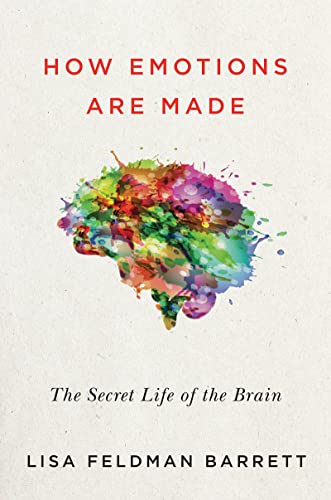
Neuroscientists have been searching for fingerprints of emotions for decades. Today, neuroscientist Lisa Barrett breaks down human construct emotions.
- Can you read someone’s facial expression to understand their emotional state?
- Mental illnesses can develop when body budgeting and predictions go out of whack.
Can you read someone’s facial expression to understand their emotional state?
Charle Darwin’s Book, The Expression of Emotions in Man and Animals noted that facial muscles are what expression’s human emotions. Suppose facial muscles show our emotional states. In that case, emotion scientists should be able to accurately label the human subject’s emotional state by measuring the facial muscle movement with facial electromyography (a fancy name for measuring the electric muscle movement of facial muscles).
However, the result showed a mismatch between a frowning face and a survey report for emotions. The person did not feel sad when he was frowning.
How about instructing people to match emotions with facial expressions?
Lisa Barrett did another experiment to test her theories. She divided their lab’s U.S participants into three conditions.
- Group one: read a story scenario to evoke emotion. For example, “He just witnessed a shooting on his quiet, tree-shaded block in Brooklyn.”
- Group 2: Saw facial expressions.
- Group 3: Read the story scenario and the facial expressions.
66% of participants in group one or three interpreted the situation as fear.
33% of the people in group two considered facial expression fear because the facial expressions lack contextual background information.
So, clearly, the facial expression does not tell you about the internal emotions of a scenario.
“Mapping emotion onto just the middle part of the brain, and reason and logic onto the cortex, is just plain silly,” says neuroscientist Barbara L. Fin- lay, editor of the journal Behavior and Brain Sciences.
Neuroscientists cannot confirm that the limbic system is responsible for human emotions.
So if the facial expression or the limbic system does not make human emotions. How do we experience emotions?
Dr.Lisa Barrett has come up with the theory of constructed emotions theory.
What are your body sensations?
The brain interprets body sensations based on two components: valence and arousal.
- Valance is how good or bad the feeling is
- Arousal is how energetic or drained you are.
- And these two components originate from interception.
Interception is the overall good or bad gut feeling that your body has. It origins from your internal body sensations, such as your blood pressure, immune system, heart rate, muscle tension, and digestive system state. The intrinsic activity in your brain maps out your body to produce a state of the gradient of good or bad feelings.
Neuroscientists call the gut feeling your effect. It is fabricated from interception. In short, your interoceptive networks are so powerfully connected to your predictions that they are like a deaf scientist with big headphones listening to the body. That’s why your emotions override your rational thinking.
The Brain makes predictions.
Affect is constructed based on your predictions.
Imagine you lying in a coffin, and you only have no access to sensory information, such as sound, vision, or smell. Yeah, that’s our brain in the skull. You are our brain because you use it to experience our life and initiate body movements. Your brain can only make predictions based on past experiences because that’s all it has. As for now, humans’ brains are the only known brains to make predictions and have a will to create a vision for the future.
We try to make accurate predictions because we want to save energy to survive. From an evolutionary standpoint, the brain is wired for predictions. If there is an error in the prediction, the brain can change the prediction by changing your body movements or how you perceive things. The second option is neurotically to stick with the original prediction and selectively focus your attention to fir your sensory input to the original prediction.
After the brain has made a prediction, your body needs to predict how to allocate your body’s energy. The body does something called body budgeting. The scientific term is allostasis for those who are curious.
Your brain is wired to listen to your body budget. Affect is in the driver’s seat, and rationality is a passenger.
How does the Brain Makes Sense of Body Sensations?
But affect, and interception alone cannot produce a human’s complex experience of emotions.
The third component of constructed emotion theory is concepts.
So, what the heck are concepts?
Concepts are mental categorizations.
If you see something red, you know how to categorize it like an apple or a rose, depending on the context and perception of the object. Imagine walking down the street; you identify flowers, houses, and dogs. You are experiencing the world using your concepts.
How does the brain learn an emotional idea that’s so abstract?
For example, an intensive example is that you break up multiple times. Your body produces body sensations that are slowly associated with the concept of sadness, a state that is gradually related to the concept of sadness instantly. So when you are in that body state with those body sensations, you label this interpception as sadness.
Sadness is a prototype, but there are many variations of the prototype.
Concepts are also very flexible, especially in goal-based situations. For example, you want to ace a test. You will start to think of ideas to get you to that goal. The category of the ideas holds things together.
When you experience something, you can technically choose the emotional concept to label your interceptions.
Master Your Emotions and Create Your Reality
To become an emotional master, you’ll develop emotional granularity. This means that you become fine-tuned to deconstructing your bodily sensations and not directing labeling the interception with a dynamic concept.
To improve your emotional granularity, the book offers two methods: meditation and doing activities that create awe (such as walking in nature or listening to crickets).
Those awe activities can instantly bring you to a pleasant state because you gain new concepts from reading books, checking off your bucket list, and going on adventures.
Even changing your clothes can make a big difference.
It’s all about combining your pre-existing concepts to come up with new ones. So the more concepts we have in our emotional library, the more we can identify our body sensations. You can even make up your emotional concepts.
An emotionally intelligent person not only has many concepts but also knows which ones to use and when to use.
Just like painters learn to see fine distinctions in colors, and wine lovers develop their palettes to experience tastes that non-experts cannot, you can practice categorizing like any other skill.
This reminds me of a concept from The Courage to Be Disliked.
You fabricate the emotions of anger so you can scream. Your actions determine your emotions. Absurd as it sounds.
By developing a high self-awareness of your body sensations, you can choose what actions you take to change how you feel. At least, that’s how I apply it to my life. For example, I can relabel an anxious feeling as excitement.
Mental illnesses can develop when body budgeting and predictions go out of whack.
In such a harsh environment, your brain might regularly predict that you need more energy than your body requires. These predictions cause your body to release cortisol more often and in greater amounts than you need
You start eating and sleeping poorly and neglect exercise, which throws your budget out of balance even more, and you begin to feel seriously like crap.
In depression, prediction is dialed way up and prediction error way down, so you’re locked into the past. In anxiety, the metaphorical dial is stuck on allowing too many prediction errors from the world, and too many predictions are unsuccessful.

 Priscilla Xu
Leave a reply to How to Not Die Alone: A Practical Scientific Guide to Dating – Priscilla Xu Cancel reply