
Reading Time: 6 minutes
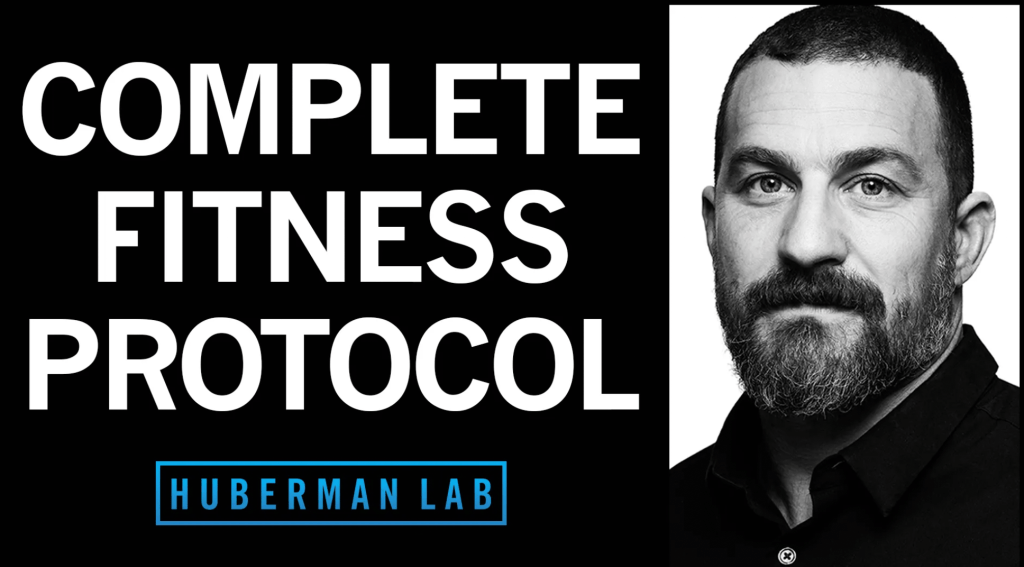
In this episode, Dr.Huberman covers a foundational framework protocol training for anyone who wants a template to start or improve their fitness journey. Each day, we focus on endurance or a specific muscle group. This framework is designed to bring fitness to all aspects of your aspect.
- Tool: Soleus (Calf) Push-Ups, Glucose Utilization & Metabolism
- Core Principles of Fitness & Modifiable Variables
- Key Principles of Resistance Training
- Day 1: Endurance Training
- Day 2: Leg Resistance, Training, Hypertrophy,
- Day 3: Heat & Cold Exposure, Recovery
- Day 4: Torso & Neck Resistance Training
- Day 5: Moderate Intensity Cardiovascular Training, Running Alternatives
- Day 6: High-Intensity Interval Training, Maximum Heart Rate
- Day 7: Arms, Neck & Calves Resistance Training
- The flexibility of Foundational Protocol, Workout Spacing
- Tool: Mind-Muscle Contraction, Physiological Sighs
- Should You Train Fasted or Fed?
- Should You Train Sick?, Ramping Training
- Tool: Deliberate Slow Breathing & Recovery
Tool: Soleus (Calf) Push-Ups, Glucose Utilization & Metabolism
- Dr.Huberman started the podcast by introducing a Micro-movement experiment at the University of Houston.
- Academic Paper Title: ”A potent physiological method to magnify and sustain soleus oxidative metabolism improves glucose and lipid regulation.”
- Soleus is an unusual muscle because it can be used continuously without getting tired.

- The study examines how people who sit a lot can increase glucose utilization and metabolism.
- The subjects do soleus push up. You raise your ankle when sitting on your chair when your knee is at a perpendicular angle.
- 52% less blood glucose after a meal and 62% decreased insulin level.
- Soleus push-ups can be a low cost too for you if you are forced to sit.
Core Principles of Fitness & Modifiable Variables
- Concepts are few, and exercises are many.
- Ask yourself: What do you want to modify to increase what aspect of fitness (listed below)?
- The 9 Variables
- Skills
- Speed
- Strength
- Power = speed x strength
- Muscular endurance
- Hypertrophy
- Anaerobic
- Dr.Huberman suggests his listeners check out the episode on Dr.Andy Galpin for the full explanation of all the fitness principles.
- Remember that progressive overload and Adaptation are a byproduct of stress.
Key Principles of Resistance Training
- The session is around 60 minutes of hard work.
- 10 minutes of warm-up and 50 minutes of hard work where you struggle to finish the last reps.
- Everyone needs to train their muscle after 48 hours for muscular growth.
- This is not true because everyone can have a different recovery rate.
- Dr.Huberman trains each muscle group in 2 sessions: directly and non directly in the week.
- You pick your exercises based on what you want to do with your fitness goals.
- Find an exercise to get that muscle into a strong position and another to help your contractions in the shortened place.
- Lower repetition, heavier weights —> more volume (physical work exerted)
- Higher repetition —> lower sets.
- Dr. Huberman’s example: For one month, you train 5-8 reps with heavyweight and 3-4 sets per exercise with 2-4 minutes rest; next month, switch to 8-15 reps with lighter weight 2-3 sets per exercise with 90-second rest.
- For hypertrophy, you can do 5-30 reps. You can change the repetition range to offset boredom.
Day 1: Endurance Training

- The goal is to get 60-70 mins of zone 2 cardio.
- Signs you are in Zone 2 cardio: You are breathing faster than usual and can still speak. If you go a bit faster, you won’t be able to talk.
- Any activity that allows you to have sustainable movement. Those include rowing, cycling, hiking, or elliptical.
- Add a weight vest to increase the difficulty and effort required. This can be beneficial if someone is not as fit as you and you need to go on a hike with them. A weighted backpack can serve the same purpose.
- 75 mins of zone two cardio is foundational for your cardiovascular fitness
- It is better to do 180-200 minutes of cardiovascular exercise per week. It has plenty of positive benefits for health and longevity, muscle, and the ability to use your body.
- Your legs won’t be too sore after zone 2 cardio.
Day 2: Leg Resistance, Training, Hypertrophy,
- Target muscles: Quadricep, hamstring, and calves.
- The purpose of this session is to maintain strength in the legs and set many metabolic processes. In addition, The anabolic hormones, such as growth hormone, shift your tendon, ligament strength, and overall musculature into a strong foundation.
- No workout exists in isolation because you cannot train when the muscle is sore.
Day 3: Heat & Cold Exposure, Recovery
- Heat-contrast: Changing between heat and cold water.
- Huberman goes into the sauna for 20 minutes and moves to 5 minutes of an ice bath for 5 cycles.
- You can accelerate recovery and benefit from heat/cold therapy.
- You can also do some light cardio that day.
- No data showing that you cannot do a cold shower after training.
- Cold shower and cold immersion are different because they tap into different parts of the feverous system. . Check out the cold exposure episode for more information.
- Cold shower and cold immersion are different because they tap into different parts of the feverous system. . Check out the cold exposure episode for more information.
Day 4: Torso & Neck Resistance Training
- Torso muscle includes the should, back, chest, and core.
- You must train your neck because we look at screens too much. Our default position is chin out and down.
- Here’s a video that Dr.Huberman recommends for neck training.
- Two exercises per muscle group. One pushing and a pulling exercise.
- Two exercises per muscle group. One pushing and a pulling exercise.
Day 5: Moderate Intensity Cardiovascular Training, Running Alternatives
- This session is different than Monday.
- The session’s goal is to get into zone 2 or more.
- First, warm up for 5 minutes, and then run for 70-80% of the max speed
- Max output cardiovascular work means when someone is chasing behind you with poison.
- Those include running, rowing, cycling stars, jump rope, and jacks.
- You can run up and down the stairs in the hotel or do full jumping jacks.
Day 6: High-Intensity Interval Training, Maximum Heart Rate
- The goal of this session is to train your legs again and increase your heart rate.
- Dr. Huberman’s Example: He gets his heart rate near maximum. He rides the bike for 20-30 seconds and rests for 10 seconds for 5-6 cycles.
- Sprint-job or rowing intervals are other activities you can change up your workout if you get bored with cycling.
- 220- your age is the maximum heart rate.
- You need to perform all movements with perfect form movement.
- Don’t go all out or overextend.
- Don’t go all out or overextend.
Day 7: Arms, Neck & Calves Resistance Training
- Th session trains the torso indirectly again.
- Same as day 4. 2 exercises per muscle.
- Some dipping movement will stimulate hypertrophy in the chest and shoulders.
- Pulling movement will also work too.
The flexibility of Foundational Protocol, Workout Spacing
- Life comes in the way, and you won’t always stick to your workout.
- If you don’t sleep well, the workout can be off by one day and be changed into cardio or cold/heat exploration.
- Spacing and alterations are essential.
- If you have a very terrible sleep, should you train? It’s better to skip a day.
- You can also do one hour of NSDR to recover some sleep.
Tool: Mind-Muscle Contraction, Physiological Sighs
- People don’t have balanced musculature. It’s rare to see someone who can have a strong mind for muscle connection and activation of the muscle.
- An easy test for a solid mind-muscle connection by muscle groups: If you can contract the muscle to pain with no weight, it’s easier for you to train that muscle for hypertrophy.
- Deep relaxation tool: physiological sign. Two inhale, and one bit exhale.
Should You Train Fasted or Fed?
- Nutrition is a controversial topic, so it varies from person to person.
- He likes to train but is not fed for 3-10 hours because he doesn’t eat in the morning.
- The last night of resistance training, he will eat starch for the following day so the body can have through glycogen.
Should You Train Sick?, Ramping Training
- Dr. Huberman ends the workout and does not push to maximum when he feels he’s getting sick soon.
- Do not train when you are sick.
- After laying off and coming back, you can slowly ramp up your workout for your body to get use returning, you can slowly ramp up your workout for your body to get used to again.
Tool: Deliberate Slow Breathing & Recovery
- 3-5 minutes of slow deep breaths to speed up recovery.

 Priscilla Xu
Leave a reply to Huberman’s Lab: Why and How Do We Stretch? – Priscilla Xu Cancel reply