
Lately, it’s been Taylor Swift getting married to Travis everywhere you look—it’s hard to ignore. This isn’t just about celebrity culture. It shows how “attention is monopolized by a select few people.”
It also highlights “a select few tools.” We give our attention to those with the loudest voices. We also prioritize the tools that appear the most useful.
Mind mapping is the exact same story.
Do you feel that as long as you use AI, your learning is improving? Does making the chart look beautiful enhance it? In reality, most people are just copying, moving, and arranging things. When the exam comes, their heads are still empty.
The most effective mind map isn’t the one AI draws for you. It’s the one you create using your own words and logic—something you can actually articulate and apply. Otherwise, it’s just “Fake Learning.” It makes you feel like you’re making progress. However, nothing is actually sticking in your brain.
Fake Mind Maps? Looks Hardworking, But the Brain is Asleep
Some kids draw mind maps by rearranging content. Plenty of adults do this, too. They may also use computers and AI to generate them to make it look pretty. But the brain isn’t actually engaging. This is what we call a “Fake Mind Map.”
What is a “Fake Mind Map”?
- You just copy content from a book or AI without thinking about how to categorize or connect it.
- You use a tool to generate it with one click, without engaging your brain.
- Like, how you use Notebook LM’s mind-mapping function.
- You’re just changing where the text is written. You are not trying to say it in your own words. You are not explaining it to a friend.
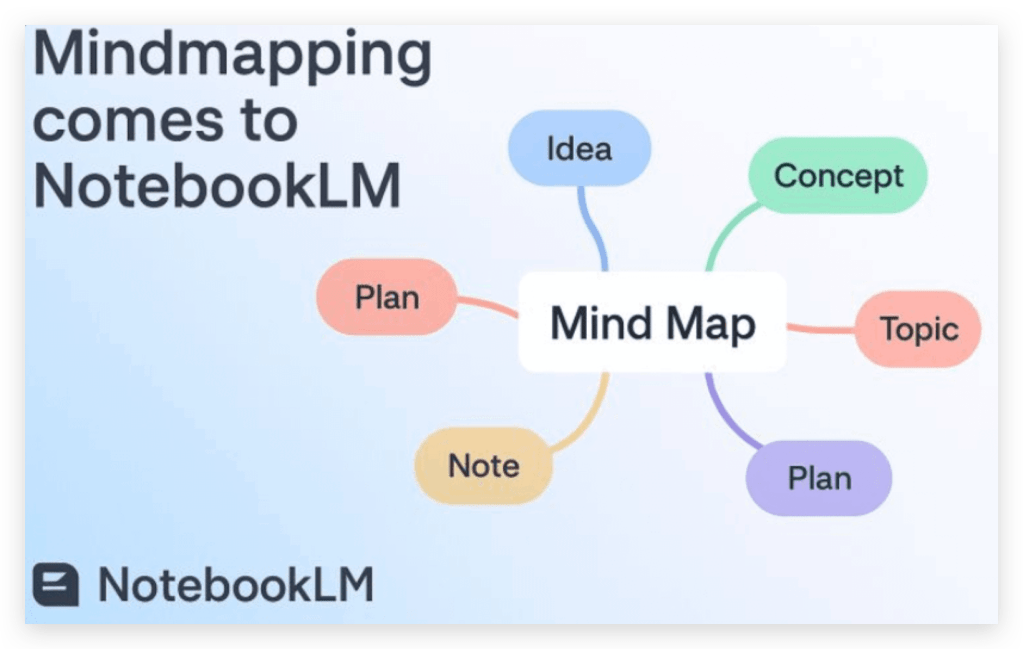
How is a “Real Mind Map” different?
Real: You decide how to categorize, you choose the connections, and you can explain it to others.
Fake: You copy, move, and arrange. After you’re done, you still don’t understand it and can’t remember it.
Which kind are you drawing?
01| Which Level is Your Mind Map?
If you learn to use mind maps correctly, you’ll find your thinking becomes clearer. You’ll also get better at distinguishing what matters.
The level of your mind map determines whether you truly understand, truly remember, and can truly apply the knowledge. This isn’t just useful for exams; it helps you find solutions faster when you hit a snag in daily life.
If you stay stuck at the simplest level, you’ll constantly hit walls. You will forget what you learned. You won’t be able to apply old knowledge to new problems.
The 3 Levels of Mindmapping is Your Best Shortcut
Level 1: Just Copying & Connecting (No Real Thought).
This is when AI or NotebookLM draws the map. It is similar to letting them draw it for you. It looks neat, but you don’t understand it or remember the content. Sometimes you just copy down what looks important, but your brain hasn’t actually switched on.
Level 2: Grouping & Adding Structure (The “Semi-Active” Trap)
You’re grouping things. You are also adding some structure. However, most of it is still just the original material. You haven’t built a new understanding; you’ve just organized the old stuff better. The knowledge structure hasn’t been reassembled to fit your existing mental framework.
Level 3: True Brain work (The “Internal GPS”)
You take new knowledge. You weave it into your own existing knowledge framework. You achieve mastery. You can explain it without looking at your notes, and you can use it to solve new problems. This is where you truly learn, remember, and clarify your thinking. At this stage, your notes will include directional arrows and markers indicating the key knowledge connections you created.
How to Level Up?
- Level 1 ➔ Level 2
- Start categorizing, zoning, and simplifying information.
- Level 2 ➔ Level 3:
- The key is to add your own experiences, metaphors, and unique classification methods. Try teaching it to someone else so the knowledge genuinely becomes yours.
Why does this matter?
If you stay at Level 1, no matter how much time you spend, the memory won’t stick. At Level 2, you feel like you’re improving. However, it’s easy to fall into “Fake Active Learning”. This means making pretty notes without forming your own knowledge.
Only at Level 3 do you have a “Self-Made GPS.” You can navigate different problems flexibly without getting lost. True mind mappers design their own navigation systems, so they aren’t afraid of new territory.
02| How does AI “Take Notes” vs. How does Your Brain “Learn”?
AI notes (like ChatGPT summaries or NotebookLM mind maps) rely on a method called Self-Attention. It automatically analyzes “which words are related,” connects the dots, compresses, and categorizes, organizing a lot of information very neatly.
This is precisely like Level 1 Mind Mapping. It looks structured, but it’s just moving data around. It doesn’t make your brain move.
What’s the human difference?
- You have to decide how to group and name the key points.
- You have to manually explain, translate, and reorganize.
- Every time you reorganize, your brain literally grows new connections.
The strongest learning happens when you can “draw it once and say it once without looking at the answer.”
AI vs. Human Brain: The Knowledge Map
- How AI Learns: AI just connects things that “appear together often.” Like ChatGPT, it compares which words hang out together and connects them mathematically. AI doesn’t understand meaning; it just looks for correlations.
- How Humans Learn: Humans engage their brains, think, and use their own words. We connect new things to stuff we learned years ago. This is the only way the brain remembers long-term.
Fun Fact Psychology Check!
Learning psychologists (like Craik & Tulving, 1975; Bjork, 2013) found that the human brain’s superpower is active organization, re-connection, and explaining things in your own way. That is how you gain the ability to apply one concept to many situations.
AI notes can only copy someone else’s map. Knowledge only becomes yours when you build the map yourself.
03| The Litmus Test. Are Your Notes Level 3?
Ask yourself these four questions.
- Can I draw this mind map without looking at the source material?
- Did I decide every group and every connecting line myself?
- Did I explain it using my own words?
- Can I explain this map to someone who hasn’t learned this yet?
If you can’t answer “Yes” to even one of these, you’re likely still at Level 1 or 2. The knowledge hasn’t truly entered your brain yet.
04| Stop Getting Lost: 3 “Learning Science” Prompts
Many people just dump data into ChatGPT and ask for a summary. But AI’s real value isn’t giving you the answer—it’s helping you “navigate” and “spark thinking.”
Here are three prompts based on the Context Engineer’s First Principle (Who, Why, What, What does success look like):
1. Use AI to List Keywords (Building the Map)
Don’t let AI explain yet. Make yourself guess first.
Prompt:
“I am a beginner just starting to learn [Topic: Active Learning], and I want to grasp the full scope of this subject.
Please list the 10 most core keywords for this topic, but do not explain or define them yet. Let me guess what they mean first.
Wait for me to write down my understanding, and then provide your explanations and examples for comparison.
My goal is to explain these in my own words and then check them against your explanation.”
2. Use AI to Define Scope (The Rookie Path)
Stop learning everything at once. Focus.
Prompt:
“I am a student contacting [Topic: Active Learning] for the first time, and I’m worried about missing the key points.
Please list the 3 sub-topics I should prioritize learning first, and explain why I need to start with these.
If there are secondary topics, please remind me that I can learn them later.
I want this to help me focus so I don’t get lost in the details.”
3. Use AI to Question Assumptions (Finding Blind Spots)
The Socratic Method: Force yourself to think.
Prompt:
"I am going to explain what I've learned from my mind map to you in my own words. Based on what I say, please help me check for any blind spots in my understanding or areas that aren't clear.

Please ask me 3 reflective questions to help me check if I've missed any connections, omitted categories, or have any biases.

Do not give me the answers directly. Use questions to force me to check my own understanding and structure.

I want to actively correct my mind map based on your questions."
 Priscilla Xu
Leave a comment